Bulacan: The Land of the Heroes
- 8 SPJ #Kenyo Talks

- Jun 11, 2022
- 3 min read
By: Gabriel Eric Bagtas
The Philippines is famous for its lively culture, rich history, and famous war heroes. Our country's colonialism created some of its most courageous citizens. Those interested in learning more about our country's national heroes frequently visit the provinces of Bulacan in Luzon. Aside from historical landmarks, these locations provide a balanced blend of rural and urban landscapes. Their characteristics are most likely why the so-called "land of the heroes" became a popular destination for individuals seeking to escape Metro Manila
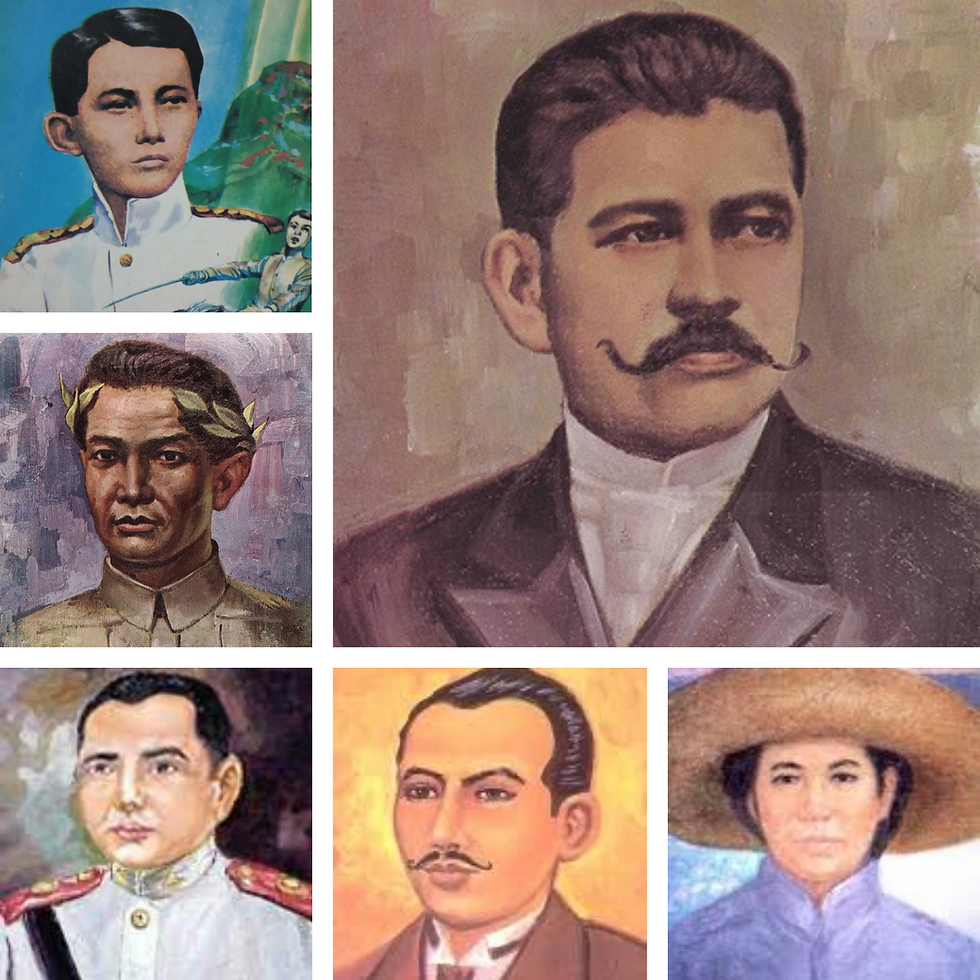
Marcelo H. Del Pilar
Marcelo H. del Pilar was born on August 30, 1850 in Bulakan, Bulacan, Philippines. He grew up to be one of the greatest propagandists, using his pen to seek Philippine independence. In 1882, he was appointed editor of the newspaper Diariong Tagalog, which sharply condemned the way the Spaniards controlled the government and treatedthe people. Plaridel, his pen name, authored satires against the Spanish friars, most notably "Dasalan at Tuksuhan" and "Kaiingat Kayo." In Spain, he succeeded Graciano Lopez Jaena as Editor of La Solidaridad, the mouthpiece of propagandists advocating for Filipino reforms. However, illness prevented him from maintaining the role for an extended period of time. Tuberculosis quickly weakened him. He died on July 4, 1896, apart from his family, in Barcelona, Spain.
Gregorio Del Pilar
Gregorio del Pilar, one of the most romantic people in Philippine history and the Revolutionary Army's youngest general, was born on November 14, 1875 in San Jose, Bulacan. Gregorio del Pilar is known as the "Hero of Tirad Pass" With only a few soldiers, the young commander fought and pushed back the formidable invading Americans, allowing Aguinaldo plenty of time to flee the conquerors. Although the battle was one-sided, Gregorio del Pilar fought bravely. And he paid with his life for his heroism. On that fatal day, December 2, 1899, he was commanding Aguinaldo's rear guard when he was shot and died.
Francisco "Balagtas" Baltazar
Francisco Balagtas y de la Cruz, often known as Francisco Baltazar, was a notable Filipino poet during the Spanish colonial period in the Philippines. For his impact on Filipino writing, he is largely regarded as one of the greatest Filipino literary laureates. He died at the age of 73 due to pneumonia and old age.
Isidoro Torres
On April 10, 1886, he was born in Matimbo, Malolos, Bulacan. He was suspected of plotting to kill the parish priest, who collected high church fees from the parishioners, when he was 16 years old. He founded numerous Katipunan chapters in Bulacan. When the revolution began, he was among the revolutionaries who fled their homes in Bulacan and moved his family to the jungle. On January 23, 1899, he led the 6,000-strong Filipino army in the parade for the opening of the Philippine Republic. He was also a revolutionary leader who battled against the Americans. On December 5, 1928, he died at the age of 62.
Mariano Ponce
Mariano Ponce was born in Baliuag, Bulacan, on March 22, 1863, the eldest of the seven children of Mariano Ponce and Maria Collantes de los Santos. He joined Jose Rizal, Marcelo H. del Pilar, Lopez Jaena, and other patriots in the crusade for the needed Philippine reforms. He assisted Lopez Jaena in founding La Solaridad in Barcelona on February 12, 1889. As managing editor, he wrote regularly for La Solidaridad on history, politics, sociology and travel under various pseudonyms, some of which were Naning, Kalipulako, and Tigbalang. When the revolution broke out in 1896, he was imprisoned in Barcelona for 48 hours on suspicion of having connections with the uprising. In 1898, Aguinaldo appointed him as diplomatic representative of the First Republic to Japan where he met his Japanese wife, Okiyo Udanwara. While enrooted to China to visit his old friend, Dr. Sun Yat-Sen, whose biography he published in 1914, he died in the Civil Hospital in Hong Kong, on May 23, 1918. His remains are now in the Cementerio del Norte, Manila.
Trinidad Tecson
She was born on November 18, 1848 at San Miguel, Bulacan. She was given the title “Mother of Biak-na-Bato” by Gen. Aguinaldo. Along with three other companions, she went to the courthouse in Kalookan to seize firearms. They overpowered the Guardia Civil and carried away their guns. She also fought with the revolutionaries in 12 battles under five Filipino generals and organized group of women to nurse wounded Filipino soldiers. She died on January 28, 1928.


Comments